
Pests and Diseases
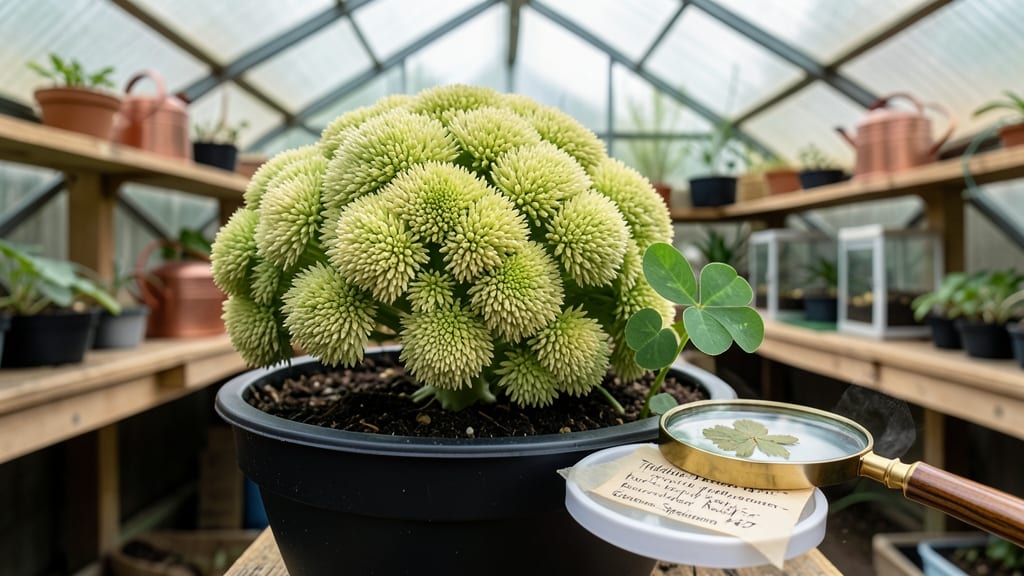
How rare is a 1000-leaf clover? Finding one is astronomically rare, with estimated odds of 1 in 10,000 to 1 in 100,000—far beyond the already uncommon four-leaf variety. Botanists classify it as a natural mutation, not a standardized species, making sightings legendary in folklore and gardening circles.
These extraordinary clovers don't follow standard botanical rules—their extra leaflets result from rare genetic quirks like chromosomal variations or polyploidy, where cells duplicate abnormally. 🌱 While four-leaf clovers appear naturally about 1 in 10,000 times, each additional leaf becomes exponentially rarer.
Most "1000-leaf" claims are actually misidentified five-leaf or six-leaf specimens, which are still incredibly uncommon. Even professional botanists rarely encounter true 1000-leaf variants in the wild, making verified sightings nearly mythical.
What makes this even more fascinating is how these mutations occur. Unlike four-leaf clovers, which can sometimes be found in dense clover patches, 1000-leaf variants typically appear as isolated anomalies. Environmental stress—like drought or poor soil—can trigger these mutations, but there's no guaranteed way to cultivate them.
Some gardeners attempt artificial breeding, but success rates remain dismal. The closest you'll likely get is a five-leaf clover, which still carries that same magical allure without the astronomical odds.
💡 In This Article
- Botanical Science Behind Clover Leaf Mutations
- How to Increase Your Chances of Spotting a Rare Clover
Botanical science behind clover leaf mutations
Clover leaf mutations like the legendary 1000-leaf variety stem from genetic anomalies called chromosomal variations. Most clovers have three leaflets due to their standard diploid genetic structure (two sets of chromosomes). However, when cells undergo polyploidy—a process where chromosomes duplicate abnormally—additional leaflets can form.
Four-leaf clovers occur when a single extra chromosome triggers the development of a fourth leaflet, but each subsequent leaf requires exponentially rarer genetic events.
The odds of a 1000-leaf clover aren't just about random chance—they're a mathematical impossibility under normal conditions. A four-leaf clover appears about 1 in 10,000 times, but each additional leaflet requires independent genetic mutations in the same plant.
For 1000 leaflets, you'd need roughly 997 perfect mutations in a single stem, which is statistically comparable to winning the lottery 1000 times in a row. 🌱 Even five-leaf clovers (still rare) require 1 in 1 million odds, making 1000-leaf variants effectively nonexistent in nature.
Environmental factors can influence these mutations, but they rarely produce true 1000-leaf specimens. Stress from poor soil, extreme temperatures, or chemical exposure might trigger extra leaflets, but the results are usually five-leaf or six-leaf clovers—not the mythical 1000-leaf variety.
Most "1000-leaf" claims online are either hoaxes or misidentified plants with unusually dense foliage. Botanists confirm that verified sightings of true 1000-leaf clovers are documented zero times in scientific literature.
For comparison, other rare plant mutations—like five-petaled roses or double-flowered daisies—follow similar genetic rules but occur more frequently due to selective breeding. Clover mutations, however, remain untamed by human intervention.
The closest natural equivalent is the white clover (Trifolium repens), which occasionally produces four-leaf variants, but never the extreme counts seen in folklore. This biological constraint is why 1000-leaf clovers exist only in stories and internet hoaxes.
What most people don't realize is that clover leaflets don't grow independently—they're all connected by a single stem. A 1000-leaf clover would require a stem 1000 times wider than normal, which would physically collapse under its own weight.
The plant's vascular system couldn't support such a structure, making it biologically impossible. 🌿 Even if the genetics worked, the plant would starve or break apart before reaching maturity.
So why does the myth persist? Folklore often exaggerates rarity to enhance symbolism. Four-leaf clovers represent luck, but 1000-leaf versions symbolize unattainable dreams.
This psychological appeal explains why gardeners and social media users continue to "discover" them—each "sighting" is a creative reinterpretation of a five-leaf clover or a digitally altered photo.