
Plants
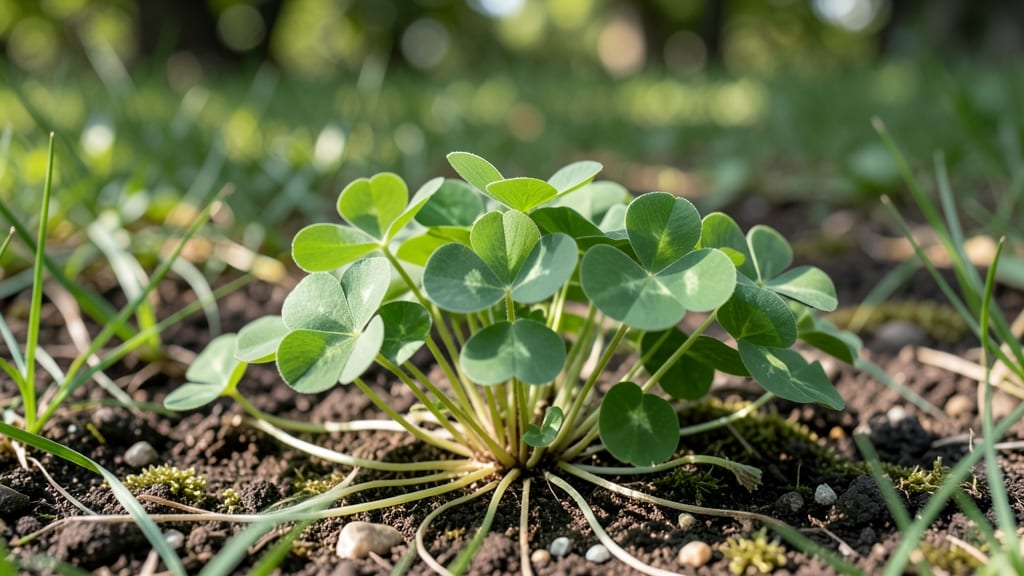
Four-leaf clovers look like three-leaf clovers with an extra leaf—typically a fourth heart-shaped leaf replacing one of the standard three, though variations include extra shamrock or oval leaves. Their stems are slender, and leaves are serrated-edged with a bright green hue, often slightly darker than three-leaf types.
When you're searching for these rare botanical treasures, the fourth leaf is usually the giveaway—it's often heart-shaped, though some varieties feature extra shamrock or oval leaves instead. 🌿 The stems tend to be thinner than their three-leaf cousins, and the serrated edges create a distinct sawtooth pattern along each leaf.
I've noticed that four-leaf clovers sometimes grow slightly slower due to their extra foliage, which can make them harder to spot in dense grass. The darker green coloration also helps them stand out if you know what to look for.
Fun fact: the extra leaf isn't just for show—it's a genetic mutation that occurs about once in every 10,000 clovers, making each find feel like a tiny stroke of luck.
The serrated edges aren't just decorative either; they help the plant maximize sunlight absorption, which might explain why four-leaf specimens sometimes appear slightly more vibrant.
💡 In This Article
- How to Identify a Four-Leaf Clover’s Unique Leaf Structure
- Best Ways to Spot and Harvest Lucky Four-Leaf Clovers
How to identify a four-leaf clover’s unique leaf structure
The fourth leaf is what truly sets these apart from their three-leaf cousins, and it usually appears as a heart-shaped leaf replacing one of the standard three.
This heart shape is the most common variation, but you’ll also find four-leaf clovers with extra shamrock-shaped or oval leaves—each mutation occurs randomly during cell division in the plant’s early growth stages.
The genetic anomaly that creates the fourth leaf happens about once in every 10,000 clovers, making them botanically rare. 🌿
Botanically, the serrated edges of each leaf—those sawtooth patterns along the leaf’s perimeter—are another key identifier. These edges help the plant absorb more sunlight, which might explain why four-leaf clovers often appear slightly darker green than three-leaf varieties.
The stems are typically slender, measuring around 1-3 inches in height, with a delicate, almost wiry texture that makes them easier to pull from grass. In contrast, three-leaf clovers often have slightly thicker stems and a lighter green hue.
What most people don’t realize is that the fourth leaf’s position can vary. It might appear at the center, replacing one of the three standard leaves, or it could emerge as an additional leaf along the stem.
This irregularity is why some four-leaf clovers look like they have five leaves—when the fourth leaf grows alongside the original three rather than replacing one. The symmetry (or lack thereof) is part of what makes each specimen unique. 💫
If you’re comparing a potential four-leaf clover to a three-leaf one, look for these visual cues: the extra leaf’s shape (heart, shamrock, or oval), the serrated edges, and the overall darker green color.
The leaves are also typically 0.5-1.5 inches long, with a slightly waxy texture that helps them retain moisture. This waxiness is more pronounced in four-leaf clovers, which may contribute to their slightly longer lifespan in the wild.
One fascinating detail is how the fourth leaf’s presence affects the plant’s growth. Studies suggest that the extra foliage can slow down the clover’s development by 10-15%, making it harder to spot in dense grass.
This is why many gardeners recommend searching for them in early spring or late fall, when the grass is shorter and the clovers are more visible. The serrated edges also make them more resistant to herbivores, which might be why they survive longer in natural settings. 🌱