
Plants
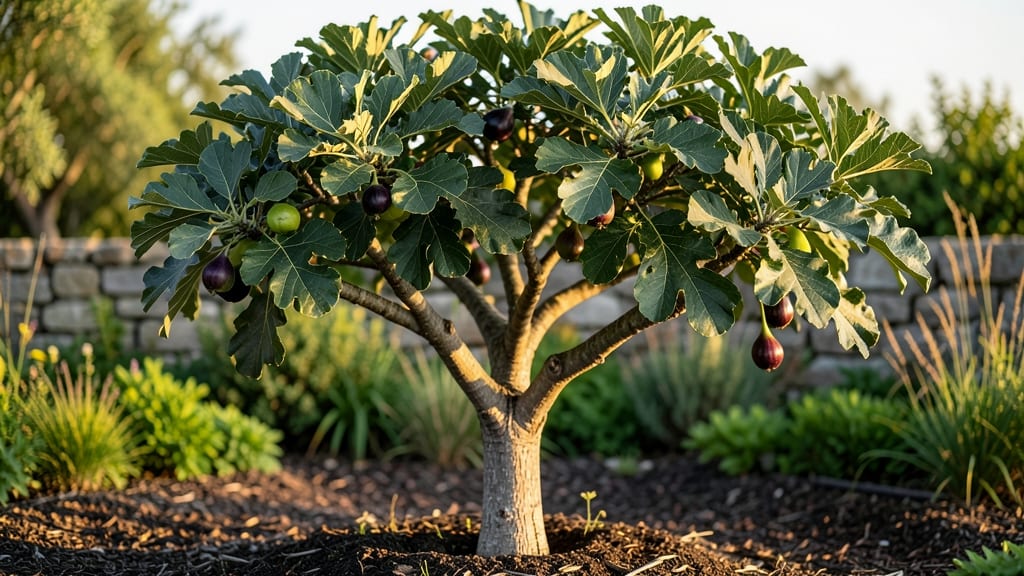
A fig tree leaf looks like a broad, deeply lobed heart with 3-5 sharp points, jagged edges, and thick veins spreading from the center. The glossy, dark green surface feels tough and leathery to the touch.
A fig tree leaf's distinctive shape sets it apart from other plants. The deep lobes create a dramatic, almost jagged silhouette, while the prominent veins give it a sculpted, almost three-dimensional look. 🌿 Unlike maple leaves, which have smooth edges, fig leaves have coarse, serrated teeth that catch the light.
I've found that these leaves often grow in clusters, with the largest ones reaching up to 8 inches long—perfect for creating shade in Mediterranean gardens.
What really helps with identification is the leaf's leathery texture. When you run your fingers across it, you'll notice how thick and slightly waxy it feels compared to softer leaves. This durability helps fig trees thrive in hot climates where water conservation is key.
The underside often has a lighter green hue, which can be a subtle but telling clue when comparing to similar-looking leaves like mulberry.
💡 In This Article
- Key Features of Fig Tree Leaves: Shape, Edges, and Vein Patterns
- How to Identify Fig Tree Leaves in Gardens and Wild Settings
Key features of fig tree leaves: shape, edges, and vein patterns
The fig tree leaf's iconic shape begins with its deeply lobed structure, resembling a stylized heart or hand with 3-5 pointed fingers. These lobes typically measure 3-5 inches wide and 4-8 inches long, creating a dramatic silhouette that's immediately recognizable.
The central lobe is usually the largest, with secondary lobes tapering outward like a fan. This lobing pattern distinguishes it from oak leaves, which have more rounded lobes, and mulberry leaves, which are simpler and less pronounced.
The edges of a fig leaf are never smooth—they feature coarse, serrated teeth that create a jagged outline when viewed from above. These teeth are more pronounced than those on maple leaves and give the leaf a rough texture when touched.
The veins are another standout feature: they form a palmate pattern, meaning they radiate outward from a single central point like spokes on a wheel. This contrasts with pinnate venation (like in walnut leaves), where veins run parallel from a central stem.
The main veins are thick and raised, giving the leaf a sculpted, almost three-dimensional appearance.
The leaf's surface is where you'll notice its glossy, dark green color, which comes from a waxy cuticle that helps reduce water loss—a survival adaptation for fig trees in dry climates.
This leathery texture makes fig leaves feel thick and slightly rubbery to the touch, unlike softer leaves that feel delicate. The underside often has a lighter green hue and may appear slightly fuzzy, especially on younger leaves.
This color contrast can be a helpful identification clue when comparing to similar leaves like those from the Ficus lyrata (fiddle-leaf fig), which lack the same level of lobing.
One fascinating detail is how the leaf's shape changes slightly depending on the fig variety. For example, the common fig (Ficus carica) has more pronounced lobes compared to the weeping fig (Ficus benjamina), which tends to have narrower, less dramatic lobing.
The size also varies: mature fig tree leaves can reach up to 12 inches long in some tropical varieties, while smaller garden figs may stay closer to 6 inches.
These variations help explain why fig leaves can sometimes be mistaken for other tropical plants like the Monstera deliciosa, which has large, glossy leaves but lacks the deep lobing.
Seasonal changes also play a role in leaf appearance. New growth emerges as a lighter green and slightly softer, gradually darkening and thickening as it matures. In cooler climates, fig leaves may develop a slight reddish tint in fall before dropping, though this is less common in tropical varieties.
The leaf's arrangement on the stem is another key feature: fig leaves grow in spirals along the branch, with each leaf emerging at a 90-degree angle from the previous one—a pattern called phyllotaxis.
When identifying fig leaves, pay special attention to these three features: the deep lobing, the palmate vein pattern, and the leathery texture.
Together, they create a unique combination that sets fig leaves apart from nearly all other common plants. 🌿 The next time you see a leaf with this dramatic shape, you'll recognize it instantly as a classic fig tree identifier.