
Diseases
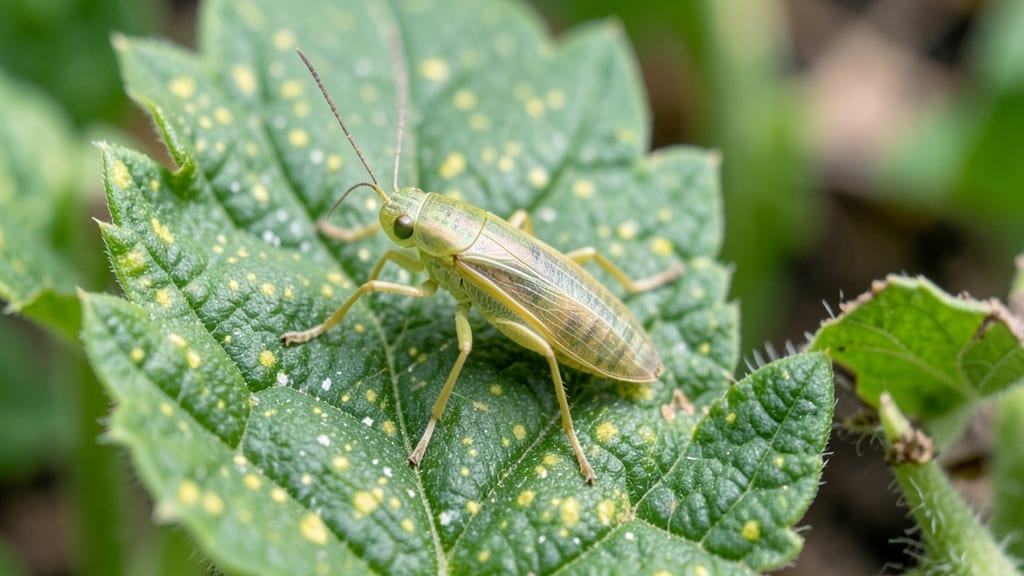
A leafhopper is a small, wedge-shaped insect that feeds on plant sap, often causing damage to leaves and stems by injecting toxins while sucking fluids. Their rapid movement and tiny size make them difficult to spot but common in gardens and landscapes.
Leafhoppers belong to the Cicadellidae family and get their name from how they cling to leaves while feeding. 🌿 These pests use specialized mouthparts to pierce plant cells, sucking out nutrients while leaving behind a toxic saliva that causes yellowing or brown spots on foliage.
Their life cycle includes eggs, nymphs, and adults, with some species producing multiple generations per year. What makes them particularly troublesome is their ability to spread plant diseases as they move between plants.
You'll often find them in vegetable gardens, ornamental plants, and fruit trees, where they thrive in warm weather. The damage they cause—called stippling—can weaken plants and make them more susceptible to other pests.
While they're tiny (usually less than 1/4 inch long), their jumping ability and rapid movement make them hard to catch by hand. Regular garden inspections, especially under leaves, can help you catch infestations early before they spread.
💡 In This Article
- Leafhopper Anatomy and Feeding Behavior Explained
- Identifying Leafhoppers: Signs, Symptoms, and Prevention Tips
Leafhopper anatomy and feeding behavior explained
The leafhopper's most striking feature is its specialized piercing-sucking mouthparts, which function like tiny hypodermic needles. These appendages can penetrate plant cells with remarkable precision, allowing them to extract sap while injecting salivary enzymes that break down plant tissues.
The enzymes contain phytotoxins that disrupt the plant's natural processes, creating those distinctive yellow or brown stippled patterns on leaves. 🔬 Unlike aphids that feed on softer plant parts, leafhoppers target the vascular system, which is why their damage often appears as irregular patches rather than uniform discoloration.
Leafhoppers measure between 1/8 to 1/4 inch in length, with their wedge-shaped bodies designed for rapid movement. Their hind legs are powerful, enabling jumps up to 2 feet when disturbed—a defense mechanism that makes them nearly impossible to catch by hand.
The adults typically have clear or semi-transparent wings folded over their backs, while nymphs (immature leafhoppers) lack wings and resemble tiny, pale green grubs. Their life cycle spans 4-6 weeks in warm conditions, with some species capable of producing 5-7 generations per year.
The feeding process itself creates a cascading effect in plants. As leafhoppers extract sap, they also excrete honeydew—a sticky residue that attracts ants and promotes the growth of sooty mold, a black fungal growth that further weakens plants.
This honeydew production explains why you might notice ants trailing along plant stems where leafhoppers are active. The combination of direct feeding damage and secondary infections often leads to reduced photosynthesis and stunted growth, making leafhoppers particularly problematic for young or stressed plants.
What makes their damage pattern unique is how they feed in random, scattered clusters rather than continuous lines. Each feeding puncture creates a tiny wound that doesn't heal uniformly, resulting in the characteristic stippled appearance that distinguishes leafhopper damage from other sap-sucking insects.
This irregular feeding pattern is why you'll often see damage concentrated on the upper surfaces of leaves, where the insects can feed undisturbed by wind or rain.
Interestingly, leafhoppers play a role in plant pathology beyond direct feeding. Their mouthparts can transmit plant viruses like aster yellows or Pierce's disease, which affect hundreds of plant species. The transmission occurs when an infected leafhopper feeds on a healthy plant, injecting viral particles along with its saliva.
This makes early detection and control particularly important for gardeners working with susceptible crops like grapes or tomatoes.
In terms of plant response, the injected toxins trigger a defense mechanism where the plant attempts to compartmentalize the damage by creating brown or dead tissue around feeding sites.
This is why you'll often see halo patterns around feeding punctures—each puncture becomes the center of a small area of damaged cells. The plant's inability to repair these microscopic wounds efficiently is what leads to the visible stippling that signals a leafhopper infestation.
Understanding this feeding behavior helps explain why leafhoppers can cause significant damage despite their small size. Their ability to move rapidly between plants, combined with their efficient feeding mechanism and disease transmission capability, makes them one of the most persistent pests in garden ecosystems. 🌱