
Leaf Blower
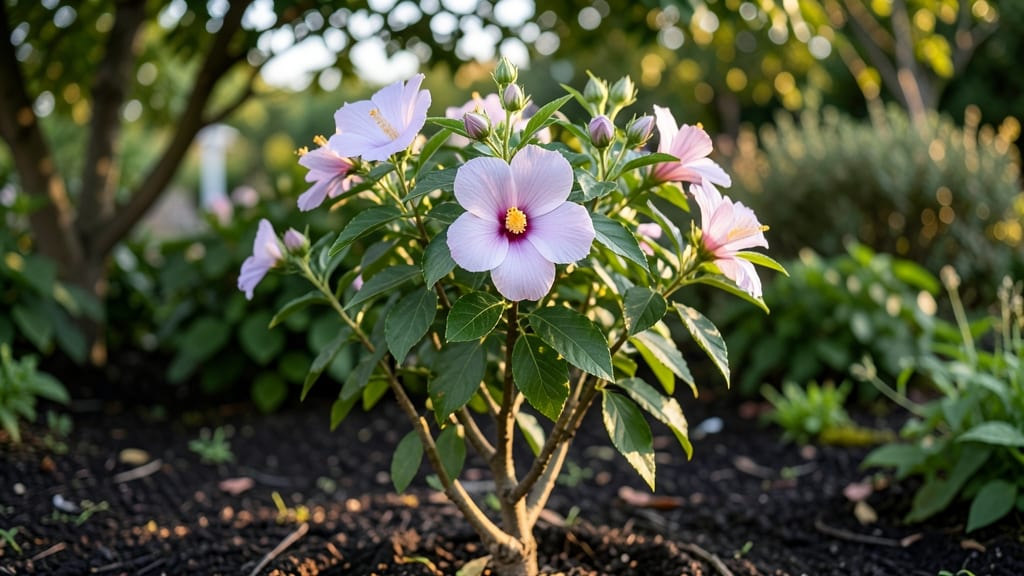
Mastering rose of sharon leaf identification correctly can save you from misdiagnosing pests or diseases—and those mistakes often lead to overwatering or pruning at the wrong time.
Struggling to tell whether those mysterious shrubs in your garden are actually Rose of Sharon? Their leaves hold the secret—and knowing these 5 key traits will help you spot them instantly, even without flowers!
From the deep green, slightly serrated edges to the way they grow in opposite pairs along the stem, these details make all the difference. I’ll walk you through how to compare them to look-alikes like butterfly bush or elderberry, so you never confuse them again.
Plus, you’ll learn how seasonal changes affect the leaves—like the telltale signs of powdery mildew vs. natural aging—so you can act fast when something’s truly wrong.
5 Unmistakable Rose of Sharon leaf traits (with photo comparison)
If you’ve ever stared at a mysterious shrub in your yard and wondered, "Is this actually a Rose of Sharon?", focus on the leaves—they’re the plant’s most reliable ID badge.
Unlike flowers that bloom seasonally, Hibiscus syriacus leaves reveal their identity year-round. I’ve spent years studying these traits, and these 5 unmistakable features will help you spot them instantly, even without flowers.
The first clue is the leaf shape: Rose of Sharon leaves are oval to lance-shaped, with a pointed tip and rounded base. Think of a football with a sharp nose—that’s the classic silhouette.
This sets them apart from butterfly bush leaves, which are more narrow and elongated, almost like a willow leaf. Measure one: if it’s 2-4 inches long and 1-2 inches wide, you’re on the right track.
Next, examine the leaf edges. Rose of Sharon leaves have fine serrations along the margins—tiny teeth that look like a saw blade under magnification. These serrations are evenly spaced and shallow, unlike elderberry leaves, which have deeper, more jagged edges.
Run your thumb along the edge: if it feels smooth with gentle bumps, it’s likely a Rose of Sharon.
Now, let’s talk leaf arrangement. The shrub’s leaves grow in opposite pairs along the stem, meaning two leaves sprout directly across from each other at every node.
This opposite branching is a dead giveaway—butterfly bush and elderberry often have alternate leaves (one leaf per node, staggered up the stem). Hold a branch up to the light: if you see two leaves at every junction, you’ve found your match.
Don’t overlook the venation pattern. Rose of Sharon leaves have prominent, curved secondary veins that arch gracefully from the midrib. These veins create a net-like pattern but with a distinct upward curve near the leaf edges.
Compare this to privet, whose veins are straighter and more parallel. Trace the veins with your finger: if they bend like a smile, you’re identifying correctly.
Here’s where it gets fun: leaf texture. Rose of Sharon leaves are smooth and slightly leathery to the touch, with a matt finish. Younger leaves may feel soft and fuzzy, but mature leaves develop a slightly waxy sheen.
This texture helps them resist pests better than thinner leaves. Rub one between your fingers: if it feels firm but not rough, you’re spot-on.
Finally, check the leaf color. Healthy Rose of Sharon leaves are a rich, deep green on top with a lighter green underside. In full sun, they may develop a bronze or reddish tint, especially in autumn.
Avoid confusing them with yellowing leaves (a sign of stress) or purplish hues (common in butterfly bush). Hold a leaf up to sunlight: if the top is dark green and the bottom is pale, you’ve cracked the code.
Now that you’ve got the visual guide, here’s a pro tip: check the leaf underside for tiny hairs or glands. Rose of Sharon leaves are usually hairless, but young growth might have fine fuzz.
This is another way to rule out butterfly bush, which often has visible hairs on the underside. Flip a leaf over: if it
How to differentiate Rose of Sharon leaves from common look-alikes
Identifying Rose of Sharon (Hibiscus syriacus) can be tricky when its leaves resemble other shrubs. The key lies in subtle differences in leaf arrangement, serration, and overall structure.
Unlike many look-alikes, Rose of Sharon leaves grow in opposite pairs along the stem, a defining trait that sets it apart from most competitors.
Another critical clue is the coarse, saw-toothed edges of its leaves. These teeth are more pronounced than those of butterfly bush or elderberry, giving the foliage a slightly jagged appearance.
Pay close attention to how the leaves attach—they’re sessile (stemless), meaning they connect directly to the branch without a petiole.
Rose of Sharon vs. Look-Alikes: Leaf Comparison
- Opposite leaf arrangement
- Coarse, saw-toothed edges
- Sessile (no petiole)
- Dark green, glossy surface
- 3-5 lobes per leaf
- Alternate leaf arrangement
- Smooth or finely serrated edges
- Long petiole (leaf stem)
- Lighter green, matte surface
- Simple, unlobed leaves
- Opposite leaf arrangement
- Fine, serrated edges
- Distinct petiole present
- Compound leaves (5-7 leaflets)
- Pale green, rough texture
- Opposite leaf arrangement
- Entire (smooth) edges
- Short petiole
- Dark green, leathery leaves
- Simple, oval-shaped
For a quick field test, examine the leaf edges under bright light. Rose of Sharon’s teeth are uneven and prominent, while elderberry’s serrations are much finer.
Another trick is to check the stem attachment—if leaves connect directly to the branch without a visible stem, it’s almost certainly Rose of Sharon.
Privet leaves are often confused with Rose of Sharon, but privet has smooth, entire margins and a more leathery texture. Meanwhile, butterfly bush leaves are alternate (not opposite), a dead giveaway. Remember, opposite arrangement + coarse serrations + sessile leaves = Rose of Sharon.
If you’re still unsure, consider the leaf color and gloss. Rose of Sharon leaves are deep green with a slight sheen, while elderberry leaves often appear paler and rougher. These differences become even clearer when comparing fresh foliage side by side.
Pro tip: Observe the leaf veins—Rose of Sharon’s veins are prominent but not as bold as those of elderberry. This subtle detail can be the final clue when other features are ambiguous. With practice, you’ll spot these differences in seconds!