
Propagation
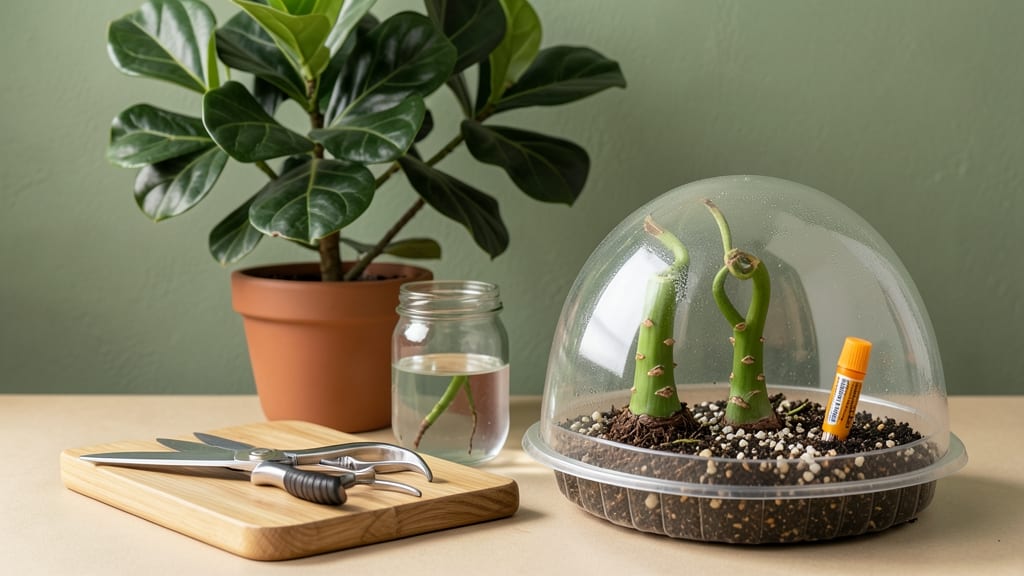
The best place to cut your fiddle leaf fig for propagation is just below a node—those little bumps where leaves grow. 🌱 I’ve propagated dozens this way, and the secret lies in those nodes: they’re packed with growth hormones that spur roots faster than cuts without them.
A clean cut at the right spot means roots appear in 2-4 weeks instead of months.
You’ll need sharp pruners (sterilized with rubbing alcohol) and a healthy plant—never take more than 1-2 stems from one fig at a time. The cut should be at a 45-degree angle, about ½ inch below the node, to maximize surface area for root growth.
Avoid cutting too close to the base or you risk damaging the mother plant.
Once you’ve made the cut, let it callus over for 24 hours before dipping in rooting hormone (optional but helpful). Place the cutting in moist potting mix or water, keeping it in bright, indirect light. Within weeks, you’ll see tiny roots forming—proof you’ve hit the sweet spot for fast propagation.
This method works year-round, but spring and summer give the fastest results. Whether you’re reviving a leggy plant or sharing cuttings with friends, these precision points make all the difference. Let’s grow your collection!
Common Triggers for Trimming Mistakes
When propagating your fiddle leaf fig (Ficus lyrata), knowing where to cut isn’t just about luck—it’s rooted in plant biology and growth science.
If you’ve ever struggled with propagation failures or stunted growth, the issue often stems from misunderstood triggers that influence how (and where) your plant responds to pruning. Let’s break down the real reasons why you might hesitate—or worse, mishandle—this critical step.
Fiddle leaf figs rely on auxin, a natural plant hormone, to regulate growth and root development. When you cut a stem, the plant’s auxin levels drop sharply at the wound site.
If you cut too high (close to a leaf node) or too low (into the woody stem), you disrupt the hormone’s flow, leading to:
- Poor root initiation: Auxin triggers root growth at nodes (the bumps where leaves or stems emerge). A cut too far from a node starves the cutting of this hormonal signal, delaying—or preventing—root formation.
- Callus formation failure: The plant’s protective callus (a scab-like layer) forms slower when auxin is low, making the cutting more susceptible to rot or bacterial infections.
- Weak stem regeneration: If you sever a stem mid-node, the plant may produce multiple weak shoots instead of a single strong root system, leading to leggy or unstable cuttings.
Actionable fix: Always cut just below a node (where the leaf stem meets the main branch) at a 45-degree angle. This maximizes auxin exposure and ensures the cutting has the best chance to redirect hormones toward root growth.
The fiddle leaf fig’s nodes are its growth command centers. Each node contains meristematic cells—undifferentiated cells that can develop into roots, leaves, or stems—depending on environmental cues. If you ignore node placement, you risk:
- Blind cuts: Cutting between nodes (internodes) leaves no active growth points for roots to emerge. The cutting may survive but remain rootless indefinitely.
- Uneven propagation: Nodes closer to the soil (lower on the stem) are more primed for rooting due to higher humidity and moisture. Cutting too high ignores this natural gradient.
- Stunted mother plant: Removing a stem above a node without a backup growth point can leave the parent plant with a bare spot, disrupting its symmetry and health.
Actionable fix: Use a magnifying glass to spot nodes (they look like small bumps or rings on the stem). Aim to cut 1–2 inches below a node for optimal rooting. Pro tip: Count nodes from the base—the 3rd–5th node from the soil line often yields the hardiest cuttings.
Even the most precise cut can fail if the cutting isn’t placed in the right conditions immediately after pruning. Fiddle leaf figs are sensitive to:
- Temperature shock: Dropping below 65°F (18°C) or exposing the cutting to drafts slows cellular repair and auxin production, halting root growth.
- Humidity imbalance: Low humidity (<40%) causes the cut end to dry out before roots form, while high humidity (>70%) without airflow promotes fungal growth.
- Light exposure: Direct sunlight on fresh cuts increases ethylene gas production, which accelerates aging and weakens the cutting’s ability to form roots.
Actionable fix: After cutting, dip the stem in rooting hormone (optional but helpful) and place it in a humidity dome or sealed container with a moist rooting medium (perlite + sphagnum moss). Keep it in bright, indirect light (like an east-facing window) and maintain 70–80% humidity for the first 2–3 weeks.
Not all cuts are equal—and neither are the tools you use. A jagged, crushed, or overly clean cut can trigger:
- Cell damage: Dull scissors or shears crush stem tissue, releasing phenolic compounds that turn brown and block root growth.
- Bacterial entry: Unsterilized tools introduce pathogens like Pythium or Fusarium, causing rot before roots can form.
- Delayed callusing: A too-perfect cut (like a laser-smooth slice) removes protective layers, leaving the stem vulnerable to dehydration.
Actionable fix: Use sharp, sterilized pruning shears or a clean knife. Make a diagonal cut (not straight) to increase surface area for root emergence. Wipe the blade with rubbing alcohol between cuts to prevent cross-contamination.
Step-by-Step Propagation Success
Ready to clone your fiddle leaf fig like a pro? The key to thriving cuttings lies in where and how you make the cut. Below, we break down the most common challenges and their fixes—plus tips to keep your new plants growing strong.
If your cuttings aren’t rooting—or worse, rotting—it’s likely due to an improper cut. Fiddle leaf figs thrive when propagated from healthy, mature stems, but the wrong spot can spell disaster.
🍳 How to Cut Correctly
- ✅ Choose the Right Stem
- Look for non-flowering, semi-woody stems (about pencil-thick).
- Avoid soft, new growth—it’s too delicate and prone to rot.
- 👨🍳 Make the Cut Below a Node
- Use clean, sharp pruners (or scissors) to slice just below a leaf node (the bump where leaves grow).
- Angle the cut at 45 degrees—this increases surface area for faster rooting.
- 🥘 Trim Excess Leaves
- Remove lower leaves to prevent rot in water.
- Keep 2-3 top leaves for energy during rooting.
🔪 What If You Already Cut Wrong?
- Too high? You’ll lose the cutting—start over with a new stem.
- Too low? The cutting may survive but root slower. Trim back to expose a clean node.
- Crushed stem? Discard it—damaged tissue won’t root well.
Whether you’re rooting in water or soil, the wrong method can kill your cuttings. Here’s how to fix common issues:
💧 Water Propagation Problems & Fixes
| Issue | Cause | Solution |
|---|---|---|
| Yellowing leaves | Too much sunlight or bacteria | Move to bright, indirect light and change water every 3-4 days. |
| Moldy water | Stagnant, dirty water | Use filtered or distilled water and add 1 drop of hydrogen peroxide per cup. |
| No roots after 4+ weeks | Weak cutting or low humidity | Try soil propagation or add a humidity dome to speed rooting. |
🌱 Soil Propagation Struggles & Fixes
| Issue | Cause | Solution |
|---|---|---|
| Wilting cuttings | Overwatering or poor drainage | Use a well-draining mix (50% perlite, 50% potting soil) and water only when dry. |
| Black, mushy stems | Fungal infection from moisture | Dip cuttings in cinnamon powder (natural antifungal) before planting. |
| Slow or no growth | Low humidity or weak cutting | Place a plastic bag over the pot (remove once roots form) and keep soil slightly moist. |
Small tweaks make a huge difference in propagation success. Try these:
- 💡 Root Hormone Boost
- Dip cuttings in rooting hormone gel before planting in soil—it doubles rooting success for fiddle leaf figs.
- 🌡️ Warmth = Speed
- Place your cuttings in a warm spot (70-75°F)—a propagator mat or sunny windowsill works.
- 🎯 Patience Pays Off
- Water-propagated cuttings may take 4-8 weeks to root. Soil-rooted cuttings can take 6-12 weeks—don’t give up!
- 🌿 Transplant Care
- Once roots are 1-2 inches long, transfer to soil. Gently remove from water to avoid root damage.
With the right cut and care, your fiddle leaf fig propagation will thrive! Now grab those pruners and get growing—your plant family is about to expand. 🌱✂️
Frequently asked questions
How do I identify the perfect node for cutting?
Look for small bumps or rings on the stem where leaves grow—these are your nodes. The ideal spot is just below a node, about ½ inch down. Use a magnifying glass if needed, as nodes on fiddle leaf figs can be subtle. Pro tip: Count nodes from the base—cuttings from the 3rd-5th node root fastest.
Can I propagate a fiddle leaf fig from a leaf cutting?
No, leaf cuttings won't root successfully. Fiddle leaf figs need stem cuttings with nodes to produce roots. If you try leaf propagation, you'll likely just get moldy water or a dead cutting. Always use stem sections with at least 1-2 nodes for best results.
What's the best time of year to propagate?
Spring and summer are ideal when your plant is actively growing. During these seasons, your fiddle leaf fig has more energy to produce roots. Avoid winter propagation—your plant's growth slows down, making rooting much harder. Even in cooler months, you can try, but success rates drop significantly.
How many stems can I safely take from one plant?
Never take more than 1-2 stems from a single plant at once. Taking too many weakens the mother plant and stresses it. If you need multiple cuttings, space them out by 2-3 weeks between propagations. This gives your plant time to recover and maintain its health.
What if my cutting starts rotting in water?
This usually means the cut was too low (missing nodes) or the water was dirty. First, remove the cutting and let it dry/callus for 24 hours. Then try soil propagation instead—use a mix of perlite and sphagnum moss and keep it in a humidity dome. Change water completely every 3-4 days if you want to try water propagation again.