
Pests and Diseases
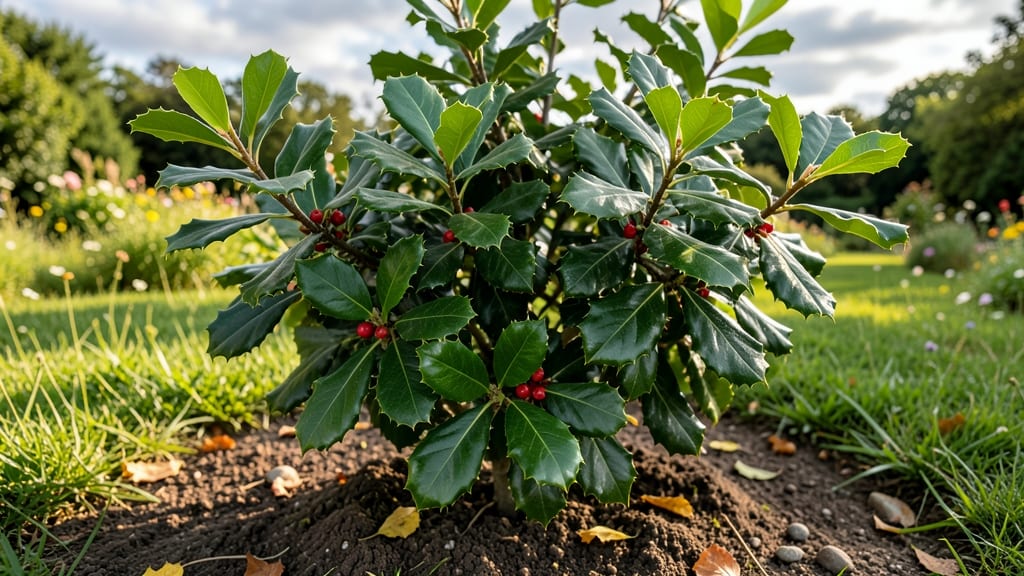
The holly leaf shape features glossy, spiny-edged leaves with sharp points and smooth, waxy surfaces, usually appearing in paired clusters along stems. Their stiff, leathery feel and jagged edges set them apart from other evergreens like boxwood or magnolia.
Recognizing holly leaves starts with their distinctive paired arrangement—each leaf sits directly across from its neighbor on the stem, creating a symmetrical pattern. 🌿 The serrated edges and pointed tips are signature traits, while the glossy surface reflects light differently than matte evergreens.
What makes identification tricky is how these features vary slightly between species, like the softer spines of English holly compared to the sharper ones of American holly. This unique combination of traits helps gardeners and wildlife enthusiasts spot holly trees even from a distance.
The waxy texture isn't just for show—it helps holly leaves repel water and pests, a survival advantage in their native habitats. When comparing holly to similar plants, pay attention to these details: boxwood leaves are broader with rounded edges, while magnolia leaves lack the spiny margins.
For accurate identification, examine both the leaf shape and arrangement—this dual approach eliminates confusion with look-alikes.
💡 In This Article
- Distinctive Features of Holly Leaf Morphology
- Identifying Holly Species by Leaf Shape
Distinctive features of holly leaf morphology
Holly leaves showcase a unique decussate arrangement, meaning each leaf pair forms a 90° angle with the next pair along the stem.
This symmetrical pattern creates a distinctive "crossed" appearance when viewed from above. 🌿 The leaves grow directly opposite each other (called "paired" or "opposite" phyllotaxy), which is rare among evergreens and helps differentiate holly from competitors like boxwood (which has spiral arrangements).
This botanical feature isn't just for aesthetics—it maximizes sunlight exposure while minimizing wind damage to the delicate leaf edges.
The spine density varies dramatically between species: American holly (Ilex opaca) typically has 3-5 sharp spines per inch along each leaf margin, while English holly (Ilex aquifolium) averages 2-4 softer spines. These spines aren't just random—they're evolutionary adaptations to deter herbivores.
The waxy cuticle layer, measuring about 0.001-0.002 millimeters thick, creates that signature glossy sheen while repelling water and insects. When you run your fingers along a holly leaf, you'll notice the leathery texture that's 2-3 times thicker than maple leaves, providing durability against harsh weather.
One fascinating detail is the vein pattern: holly leaves feature prominent midribs with secondary veins radiating at 45° angles, creating a web-like structure visible through the translucent leaf edges.
This vascular network supports the leaf's rigid structure while allowing efficient water transport. 💫 Seasonal variations also play a role—new growth in spring appears slightly lighter green and softer before developing the mature dark green to deep blue-green color of established leaves.
The undersides often show a lighter hue or fine hairs, especially in younger specimens.
Comparing holly to similar evergreens reveals key differences: boxwood leaves lack spines and have rounded lobes instead of serrations, while magnolia leaves are elliptical with smooth edges and grow alternately along stems. The paired arrangement alone eliminates confusion with these plants.
For example, while both holly and magnolia produce berries, only holly combines spiny leaves with paired stems—a dead giveaway for accurate identification. This dual characteristic (leaf shape + arrangement) is what makes holly leaves so distinctive in the plant kingdom.
What most people overlook is how the leaf tip shape varies by species: American holly ends in a sharp, triangular point, while English holly often has a more rounded apex with smaller spines. These subtle differences become crucial when distinguishing between species in the wild.
The leaf base also provides clues—holly leaves typically attach asymmetrically to the stem, with one side wider than the other, creating a slightly skewed appearance when viewed head-on. This asymmetry helps holly leaves pack more efficiently along the stem while maintaining their protective spine structure.
The waxy surface serves multiple purposes beyond aesthetics: it reduces water evaporation by up to 30% compared to non-waxy leaves, allowing holly to thrive in drier conditions. This adaptation explains why holly remains evergreen in regions with seasonal droughts.
When examining holly leaves under magnification, you'll see microscopic trichomes (hair-like structures) along the veins that further enhance water retention. These tiny features work together to create the holly leaf's signature resilience and distinctive appearance.